INDIAN CULINARY EXPERIENCES
THE FOUNDATIONAL SERIES - 2
NORTH INDIA: LANDSCAPES, COMMUNITIES
&
FOOD TRADITIONS
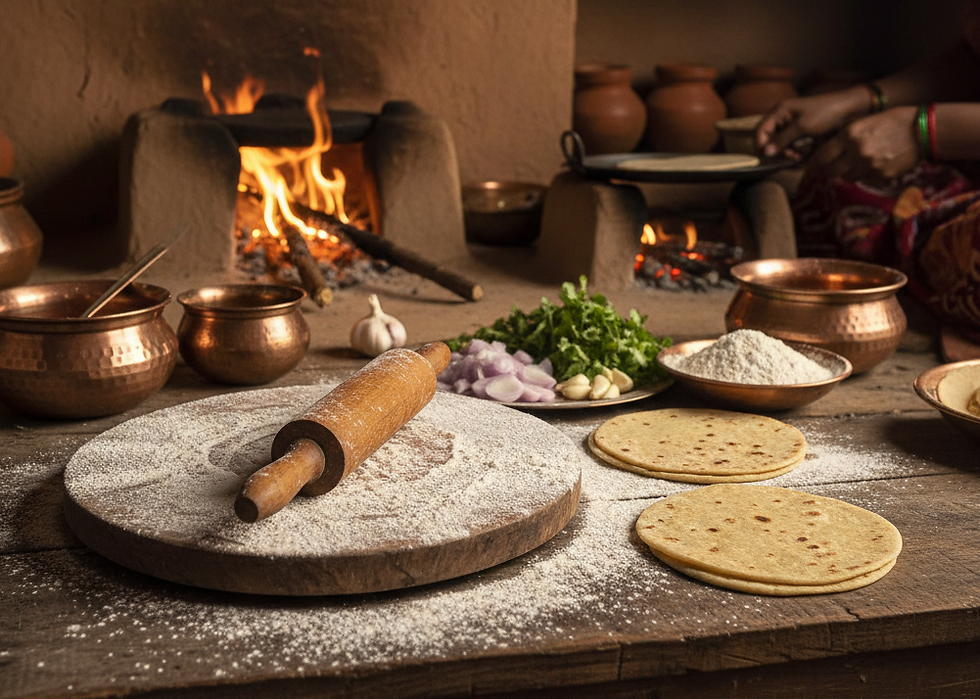
In the vast geography of Indian cuisine, the north offers a distinct landscape of wheat cultures, dairy traditions, and nomadic legacies. This program explores the culinary logic of the Gangetic plains, the artisanal breads of the mountains, and the deep influence of migration on the North Indian plate.
Duration
5 Days
Group Size
Limited to 10 Participants
TaKe Away
Participants receive a detailed
E-Booklet of the course
Location
Auroville, Tamil Nadu
THE DIALOGUE BETWEEN PLACE & PLATE

North India is often represented through a familiar collection of restaurant dishes—rich curries, tandoori breads and celebratory feasts.
Yet beyond these familiar images lies a remarkable culinary landscape shaped by mountains, deserts, fertile river plains, pastoral communities, royal courts and agricultural abundance.
This five-day experience invites participants to explore some of the diverse food cultures that have evolved across North India.
From the wheat-growing plains of Punjab to the desert kitchens of Rajasthan, from the mountain valleys of Kashmir to the slow-cooked traditions of Awadh and the grain cultures of Bihar, each region tells a different story about the relationship between people, landscape and food.
At ACE, we believe that food cannot be fully understood through recipes alone.
Throughout the program, participants explore how geography influences cuisine.
Why do dairy and wheat dominate some regions while millet becomes essential in others?
How do desert communities cook when water is scarce?
How do mountain cultures create food suited to long winters?
How did royal kitchens transform everyday ingredients into celebrated culinary traditions?
These questions form the foundation of our exploration
EXPLORATION THEMES
A deep dive into the intellectual journeys, historical contexts, and cultural insights of Indian culinary traditions. Throughout the program, participants are introduced to some of the foundational ideas that shape Indian cuisine. We explore how oils such as coconut oil, mustard oil, sesame oil and ghee influence regional food cultures. We examine the role of rice, wheat and millets in shaping meals and agricultural traditions across the subcontinent.
Participants are introduced to foundational techniques such as tadka, bhuna, fermentation and dum cooking, while also discovering the remarkable diversity of Indian breads, shared meals and banana leaf traditions.
Along the way, we explore how food travels, adapts and evolves through migration, trade and cultural exchange.

THE GEOGRAPHY OF THE NORTH
Understanding how the varying terrains—from fertile plains to arid deserts—shape the cultivation of heirloom wheat and regional mustard seeds.

THE LOGIC OF THE NORTHERN TADKA
The science of oil-based spice extraction, focusing on the specific spicing sequences used in Punjab, Rajasthan, and Kashmir.

DAIRY AS A PILLAR OF FLAVOUR
An exploration of ghee and yogurt culture, examining their role as foundational mediums for spice extraction and slow heat cooking.

COMMUNAL BREAD TRADITIONS
An inquiry into the clay oven (tandoor) and griddle (tawa) cultures that define the communal and craft aspects of bread making.

NOMADIC CULINARY PATHWAYS
Capturing the unwritten recipes and shifting food stories of communities whose culinary logic is defined by movement and heritage.

THE ARCHITECTURE OF A NORTHERN MEAL
Analyzing the geometry of the North Indian plate, the role of seasonal vegetable compositions, and the logic of communal dining.
The Five-Day Journey
DAY 01
THE GRAIN & THE FLAME
An exploration of high-altitude wheat cultures, the physics of Tandoor baking, and the culinary logic of the semi-arid northern plains.
DAY 02
THE MOUNTAIN PANTRY
Discovering the preserved traditions of the Himalayas, focused on legumes, mountain salts, and the fermentation techniques of the upper reaches.
DAY 03
THE NOMADIC KITCHEN
Tracing the unwritten recipes of migratory communities through the landscapes of Punjab and Haryana, exploring the geometry of communal clay ovens.
DAY 04
COURTLY LEGACIES & SPICE ROUTES
An analysis of the Indo-Persian synthesis, slow-heat 'dum' cooking, and the grand menu structures of the Awadhi and Mughal courts.
DAY 05
THE MODERN NORTHERN TABLE
Synthesizing the week's learnings into the contemporary context, exploring seasonal menu hierarchies and the future of northern heritage food.
International Travellers
Passionate explorers seeking a deeper understanding of India through its food, culture, landscapes and communities.
Who This Program Is For

Indian Diaspora
Individuals wishing to reconnect with the diverse culinary traditions, ingredients and food cultures of their heritage.
Media & Storytellers
Writers, photographers and filmmakers exploring food, place and culture through documentation and visual storytelling.

Cultural Explorers
Curious learners interested in the intersections of geography, community and tradition that shape culinary cultures.

DOCUMENTATION OUTCOMES
STRUCTURAL UNDERSTANDING OF FLAVOUR
Gaining a deep sensory and intellectual grasp of the Indian Culinary Tradition by analyzing the interplay of regional ingredients and climate.
DOCUMENTATION SKILLS IN CULINARY ARTS
Learning precisely how to document foundational techniques like tempering and slow heat through a scientific and cultural lens.
ARCHIVAL RECIPES & TRADITIONS
Participants engage with unwritten recipes and nomadic food stories, forming a repository of regional heritage.
GEOPOLITICAL CONTEXT OF FOOD
Understanding the historical movements, trade, and culinary migrations that have continuously redefined the Indian plate.
THE SPIRIT OF SHARED MEALS
Appreciating the communal philosophy of the subcontinental table where food serves as a bridge for human connection.
BEYOND THE NORTHERN BORDERS


SOUTH INDIAN SERIES
EASTERN INDIAN SERIES
WESTERN INDIAN SERIES
SOUTH INDIAN SERIES
KERALA SERIES
North India is the first chapter in a continent-wide exploration of culinary logic and community heritage.